
“Russian rap: new ‘Old’ School”
A portrait series dedicated to the people who shaped the musical taste of teenagers in the 2010s.
Illegal use of narcotic drugs, psychotropic substances, and their analogues is harmful to health; their illegal trafficking is prohibited and entails liability established by law.
LSP
Three letters with dozens of possible meanings, but LSP isn’t “him” — it’s “them”
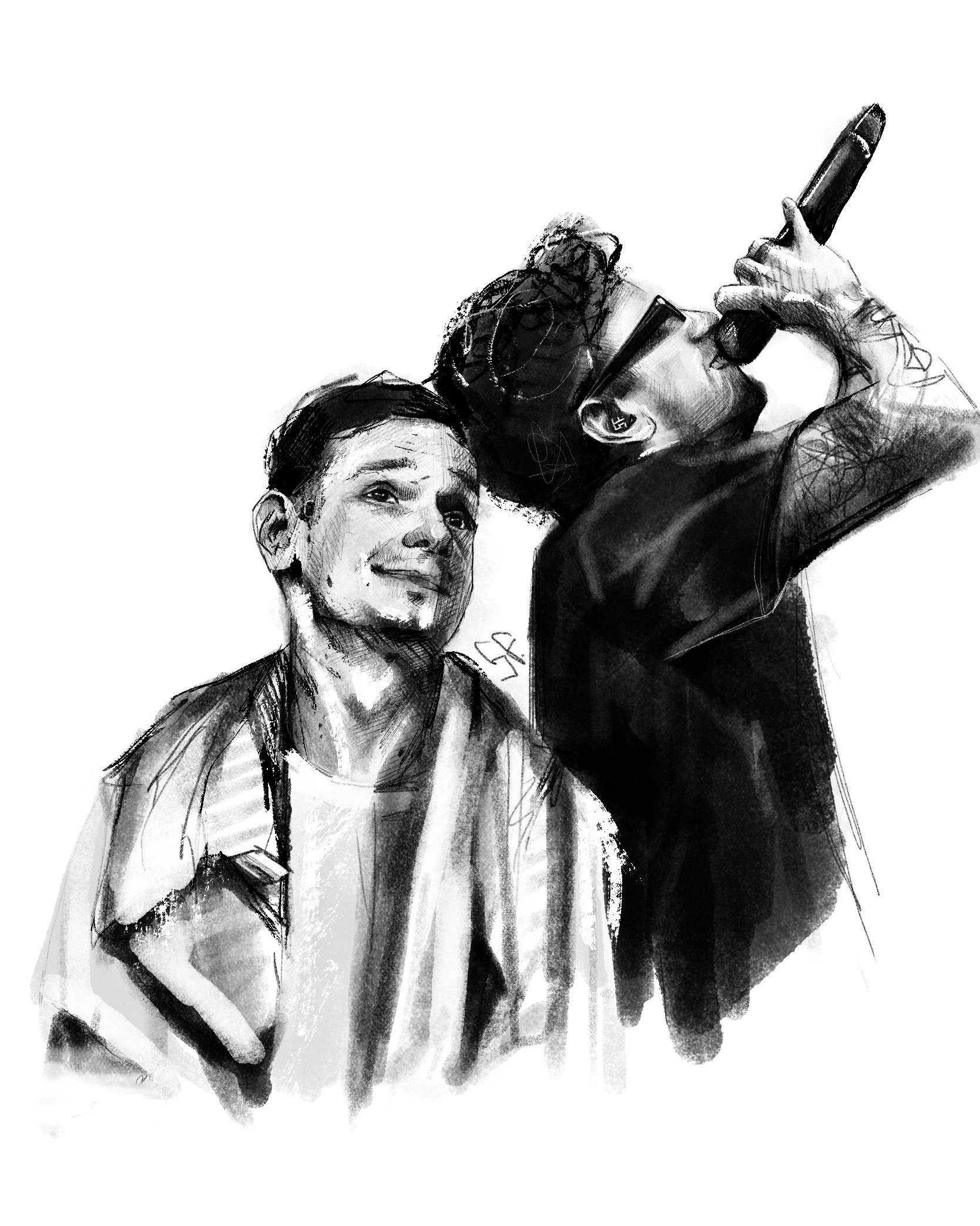
Oleg Savchenko and Roman Sashchenko — Roma Anglichanin (“Roma the Englishman”), as the entire Russian-speaking rap scene called and remembered him. They formed a duo under a single name in the early 2010s. Neither one tried to hog the spotlight, which is exactly what made their symbiosis work.
The duo existed for five years and didn’t break up over a fight for fame or money — on July 30, 2017, LSP and their fans lost part of themselves in the person of Roma Anglichanin. Today, Oleg is LSP, and it still carries the signature style the two of them built together. But for those who listened to LSP from the very beginning, that name will always be about the two of them.
The Main Trilogy of Russian-Language Hip-Hop
Within Russian-language hip-hop, there are stories that aren’t immediately obvious. They don’t always read as a single narrative, but if you look a little closer, they form a cohesive picture.
LSP’s trilogy — Magic City, Tragic City, and One More City — is one of these. On the surface, it’s a story about money, nightlife, parties, and loss. But behind the image of an initially dazzling city hides a far more personal story about a person trying to find happiness in a world where almost everything turns out to be temporary. The three records are united not just by their titles but by a recurring lyrical protagonist who lives through the same arc each time: a fall, hedonism, loss, and an attempt at rebirth — each time slightly differently.
“Magic City”
The first part of the trilogy came out in 2015 and marked, for LSP, the beginning of a new path — a bigger story. At the album’s core is a lyrical protagonist consumed by a world of temptation: strip clubs, money, the nightlife of a big city. It was on this album that the device that would become the trilogy’s signature finally took shape: the city as both a character and a trap at the same time. And the first one wasn’t just a city, but a place-as-illusion: a space where desires come true, but the price of those desires gradually becomes too high. Magic City is a city of night. Here money comes fast, emotions grow more vivid, and the consequences seem to stay somewhere outside this world.
Looking back on this period later, Oleg admitted that it was out of this “moral and emotional decline” in Magic City that, in his words, the next, more cohesive release was meant to be born.
Magic City was, overall, a fairly rowdy album — energy, dancing, fun, but by the end it all folded into a minor key. — Oleg LSP, interview with The Flow, 2017
At the beginning of the album, the listener is greeted by a narrator playing the role of a strip club promoter. The intro lays out the arc of the lyrical protagonist, whose name we’re never told. What we do know for certain, though, is what draws people to this city — what could be summed up as “LSP”: lies, lust, and vice in Magic City. And the narrator warns right away that in this artificial world of desire, there are rules — look but don’t touch, and above all, don’t fall in love with them. But our protagonist will break that rule in the very first track of the album.
Roma sent me a great instrumental — I realized I wanted to write something over it. The track 'Shest'' was needed to set the tone and setting for what was happening. — Oleg LSP, interview with The Flow, 2017
In “Shest'” (“Pole”), amid pleasure and debauchery, the protagonist considers himself smarter than everyone else and has no intention of looking for love at a strip club — but then he sees her. We don’t learn her name or anything more about her, other than that she’s a dancer and that he’s hopelessly, powerfully drawn to her body. From there, alongside Faraon, come bright flashes of emotion in “Bullet, ” something a bit calmer in “Fokus, ” and then exhaustion and a reckoning with consequences in “Urovni” (“Levels”), where he’s finally forced to find some logical end point to all the parties and the rivers of alcohol mixed with smoke. The euphoria and frenzy of “Bezumie” (“Madness”) gives way to a kind of summing-up in “Chto-to Yeshcho” (“Something Else”), where the illusions truly start to fade and honest thoughts begin to take shape.
The whole album is built in blocks, where the atmosphere gradually intensifies, the city’s brightness turns to gray, the euphoria fades, and what’s left is the comedown and the reckoning.
“Tragic City”
If “Magic City” was a bright flash — a city where everything seems possible — then its follow-up becomes the inevitable hangover after that night. “Tragic City” isn’t just a sequel to a successful album, but the flip side of that same reality. After the vivid revelry comes the protagonist’s emptiness, reflected across the album’s thirteen tracks, released in 2017.
The difference between the two cities matters a great deal here. Magic City was a place of dreams, a space where the protagonist believed happiness was hidden in money, a life of excess, and partying until dawn. Tragic City becomes the moment he realizes that even the most dazzling city cannot fill an inner void — and can, in fact, only make it bigger.
There’s no intro to greet us — instead we’re met by the track “Polzat'” (“Crawl”), which foreshadows what’s coming: refusal to accept what’s happening, self-destruction, fear, and despondency. The start of the album can be read as the protagonist’s failed attempt to return to the euphoria of Magic City, but the problem is that he’s already changed, and that moment can’t be repeated. In “Monetka” (“Coin”), you can clearly make out his attempts to close the “hole in his heart” by trying to return to the old routine of destructive but vivid sensations — only the hole keeps growing, and the problem doesn’t go away.
Escaping reality doesn’t help. So money and its sheer quantity start to offer comfort in “Den’gi ne Problema” (“Money’s Not a Problem”) — but what if even that doesn’t heal him? The protagonist revels in his wealth and success right up until the realization hits that everyday life stopped being the only problem. The second half of the track opens onto the character’s emotional decline; melancholy sets in, and reflection on the emptiness of material things awakens. LSP, once “Lozh', Strast' i Poroki” (“Lies, Passion, and Vices”), abruptly turns into “Luchshe Spoy Pesnyu” (“Better Sing a Song”) about love.
“Telo” (“Body”) became one of the most tragic and profound tracks on the album. Exhaustion is now more palpable, both materially and morally. The physical remains just physical — it gives a brief flash of feeling but doesn’t bring back the old sense of happiness, and it can’t fix anything either, since he’s “just a body that dully aches.”
Further on, our protagonist already understands the rules of this city and stops trying to break free from it — instead accepting existence, living within it. He no longer tries to maintain the image of a guy who’s in control and enjoying himself; the mask falls away and he becomes himself. The track “Belyy Tanets” (“White Dance”) marks the beginning of a stage of resignation, while “Otbros” (“Outcast”) becomes the lyrical protagonist’s confession and self-perception.
The whole of Tragic City can be read as the slow collapse of one big illusion. The protagonist begins the album believing in the old rule: if you have money, opportunities, and access to everything this world can offer, then you can win back the happiness you’ve lost. But gradually he comes to understand that the problem was never about what he lacked. It closes with the track “Plevok v Vechnost'” (“Spit into Eternity”), and the protagonist stops trying to win this game. In the end, he realizes the city was never the cause of his pain, nor the way to solve it. The real battle, this whole time, was happening inside himself. He climbs out of this city, taking all its lessons with him, and moves on into yet another city.
“One More City”
In 2020, LSP releases the follow-up, three years after Roma Anglichanin’s death. The final part of the trilogy — after watching the bright life of Magic City, then the protagonist’s fall and unraveling in Tragic City — the time comes to witness realization in One More City.
There are cities that never sleep. In places like that, it’s easy to lose yourself, because the city keeps offering up new desires and new goals, or, conversely, forces you into hiding and confronts you with nightmares. In this city, there’s no sense of an ending or of some grand adventure beginning. There’s no thrill of the unknown here, no feeling that something great lies ahead. This city dismantles the familiar mirages and shows the reality of one’s actions.
The listener is greeted by “Zolotoy Mal’chik” (“Golden Boy”), which describes the protagonist’s everyday life and principles. On the surface, it sounds calm and melancholic, but underneath that mask lies cynicism — hiding the immoral, unscrupulous daily life of a pimp behind Oleg’s own soft, gentle voice. Toward the end of the track, the atmosphere heats up, and two lives collide “at the entrance to the strip club” — since that’s exactly where the story of these cities began. “Pop Zvezda” (“Pop Star”), keeping the same rap-narration atmosphere throughout, exposes the illusion of an artist’s glamorous life: the gloss hides the truth, and everyone is replaceable once the spotlight fades. Meanwhile, our protagonist meets a “Devochka-Prisheletz” (“Alien Girl”) at a bus stop, in the track of the same name. Alienation and total loneliness collide, in a fleeting glance, with a girl who feels otherworldly and special within this city. She runs off the tram and confesses her love to the protagonist using his own words as a kind of password.
But our protagonist isn’t so pure of heart or principle — already in “Zolushka” (“Cinderella”) he becomes infatuated with his beloved’s friend. The breakup doesn’t take long to arrive, and it devastates him; all he can think about is where his love has gone — whether “she flew away, moved away, or died, ” in the track “Uuu.” Losing her was painful, especially given that it was the price of his own actions. And he turns into a “lone psycho.” Losing that love traumatizes him, and now he needs a replacement — a girl he doesn’t love, but who gives him that same feeling he once felt and so foolishly lost. She, incidentally, will start to annoy him the very next day, but the protagonist won’t give her the chance to leave; repeating the same outcome as before, he kills her, but remembers “exactly this kind of '20.” Only afterward does realization of what he’s done set in, and he retreats into “Amneziya” (“Amnesia”); the beats of the track grow heavier, and the lyrical protagonist defends himself from himself, hiding from his pressing problems using a method he already knows well — alcohol. We’re back on the same path once again.
Looking back, the protagonist identifies money and its sheer quantity as the source of his unhappiness, so in the track “Tsvetnaya Bumaga” (“Colored Paper”) he decides to burn it — declaring that money is nothing but colored paper. But burning it brings no warmth, and no love either.
The track “Odin” (“Alone”) begins, gradually leading us toward the finale. The consequences of his past choices catch up with him — a manhunt: the whole city now plastered with photos of his face. He loses everything, loses his mind, keeps running, and in complete solitude, repents. He runs, but finds a child, which pushes him toward sleep. The protagonist wakes to bright sunlight in the track “Dyuny” (“Dunes”) and comes to understand the rule: what you sow, you reap.
Critics have noted that in One More City, the fatalism of LSP’s earlier albums gives way to something closer to resignation — a kind of rebirth and acceptance that the protagonist, and Oleg along with him, only grew into over the years. The album’s final track, “Vspominay” (“Remember”), deserves special mention: starting out as an ordinary song, it transforms by the end into a direct dedication to Roma Anglichanin, becoming a symbolic farewell that closes out the entire trilogy.
