
Reel
Works inspired by characters from films and TV series across a range of genres.
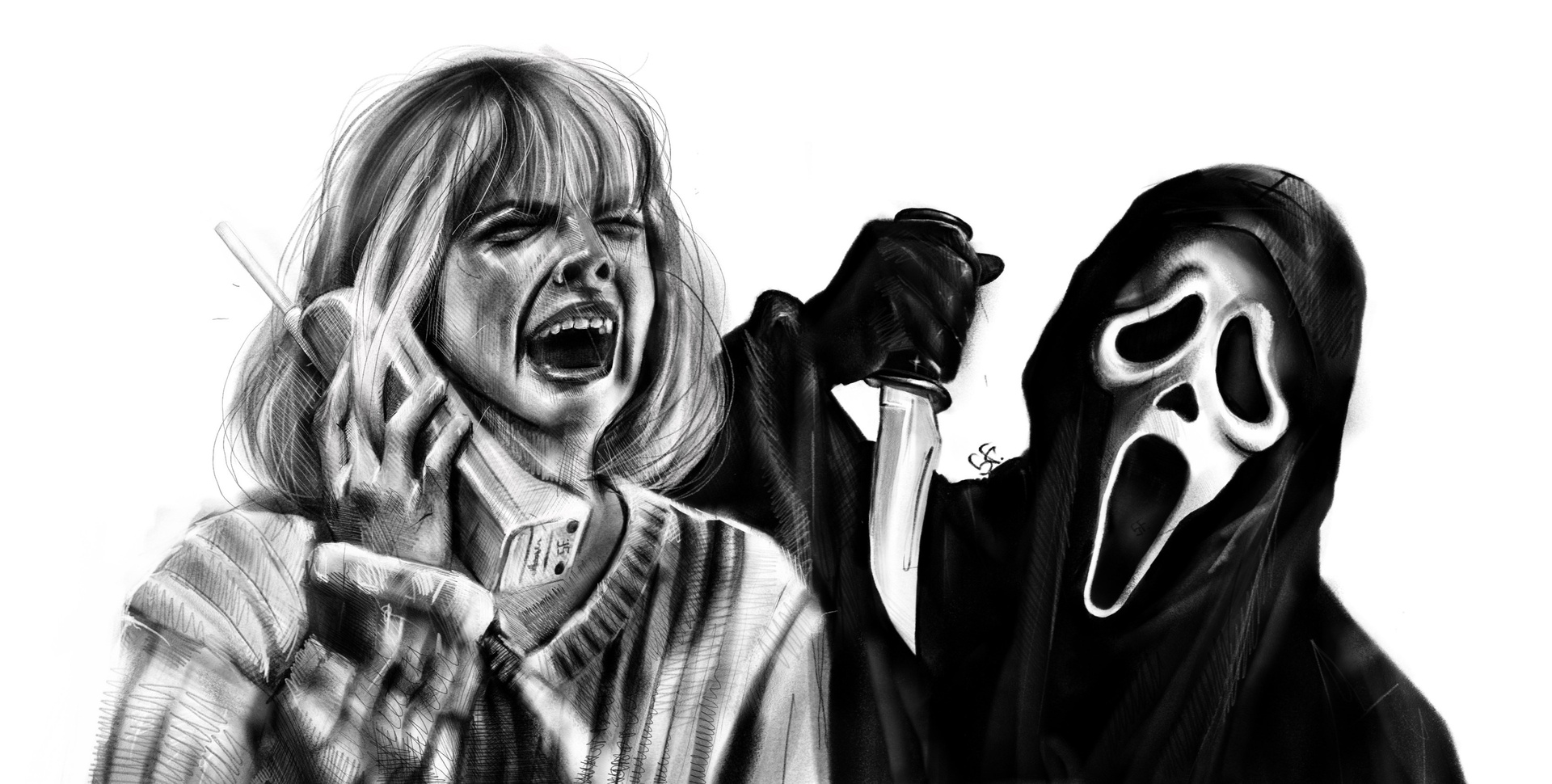
Scream 1996
What’s your favorite scary movie, Casey?
“Scream” pokes fun at genre clichés, but not from the position of a mocker — it’s one of us. It loves horror movies. It understands them.
Does sex always end in death?
All horror movies are the same. A dumb killer chases a busty airhead who always runs upstairs instead of leaving through the front door.
When Wes Craven’s “Scream” hit screens in December 1996, the slasher genre was considered practically dead and buried. Franchises like “Friday the 13th” and “A Nightmare on Elm Street” had degenerated into self-parody, and audiences were tired of the same identical blondes running upstairs instead of running out the door. Craven and screenwriter Kevin Williamson made a move that seemed reckless to the point of madness: instead of pretending the clichés didn’t exist, they let that awareness into the film itself and turned it against the characters.
The film looks at the genre through the eyes of a fan. Randy Meeks, the video store clerk and the film’s resident “genre theorist, ” doesn’t mock slashers — he adores them so much that he can recite the rules of survival like scripture:
1. You can never have sex. Big sin. Big no-no. Sex equals death, okay?
2. You can never drink or do drugs. The sin factor. It’s a sin. It’s an extension of number one.
2. Never, ever, ever, under any circumstances say “I’ll be right back.”
This is exactly why the film works simultaneously as a parody and as a fully functioning, genuinely scary slasher. When Ghostface turns the phone call into a horror-movie trivia quiz, the viewer, who grew up on these same films, gets pulled into the very same game as the victim. Irony doesn’t defuse the tension — it doubles it: we’re afraid for Casey Becker’s character while frantically trying to remember who the killer was in the first “Friday the 13th.”
But “Scream” isn’t just playing with the victim on screen — it’s playing with the audience in the theater too. The killer in the film acts as a kind of director within the director’s own design: he’s the one choosing the next victim, setting the scene, and deciding what rules it will be played by. And the viewer, watching all this, unwittingly ends up in a symmetrical position — also playing, just a different game: who is the killer?
This works thanks to a simple but precise structural choice in the script. Within the first half hour, the film outlines the core circle of people for us: Sidney, Tatum, Billy, Stu, Randy, Dewey, Sidney’s father, the journalist Gale. No new figures will appear after that. So the viewer’s task isn’t to guess among an endless number of possibilities, but to find, among familiar faces, who doesn’t quite fit, who has no alibi, whose gaze lingers a fraction of a second too long. The viewer becomes an involuntary detective, and in this sense becomes a participant in the very same game as the characters — only what’s at stake for them isn’t their life.
This is where “Scream’s” irony reaches a new level. We watch teenagers who know the rules of the genre and still get them wrong when applying that knowledge to their own lives — while we ourselves apply those very same viewing skills, trying to figure out the killer before Sidney does. The film exploits our genre-savviness exactly the way the killer exploits the victims' naivety: both are forms of manipulation, and Craven makes his visible, but that doesn’t stop it from working. The commercial and cultural effect was enormous: the film didn’t just revive the slasher — it relaunched the entire late-'90s teen horror wave.
