
Reel
Works inspired by characters from films and TV series across a range of genres.
Dracula: A Love Tale
I loved God more than anyone, and I considered Elisabeta His greatest gift. But He took her. Now I take my soul back from God.
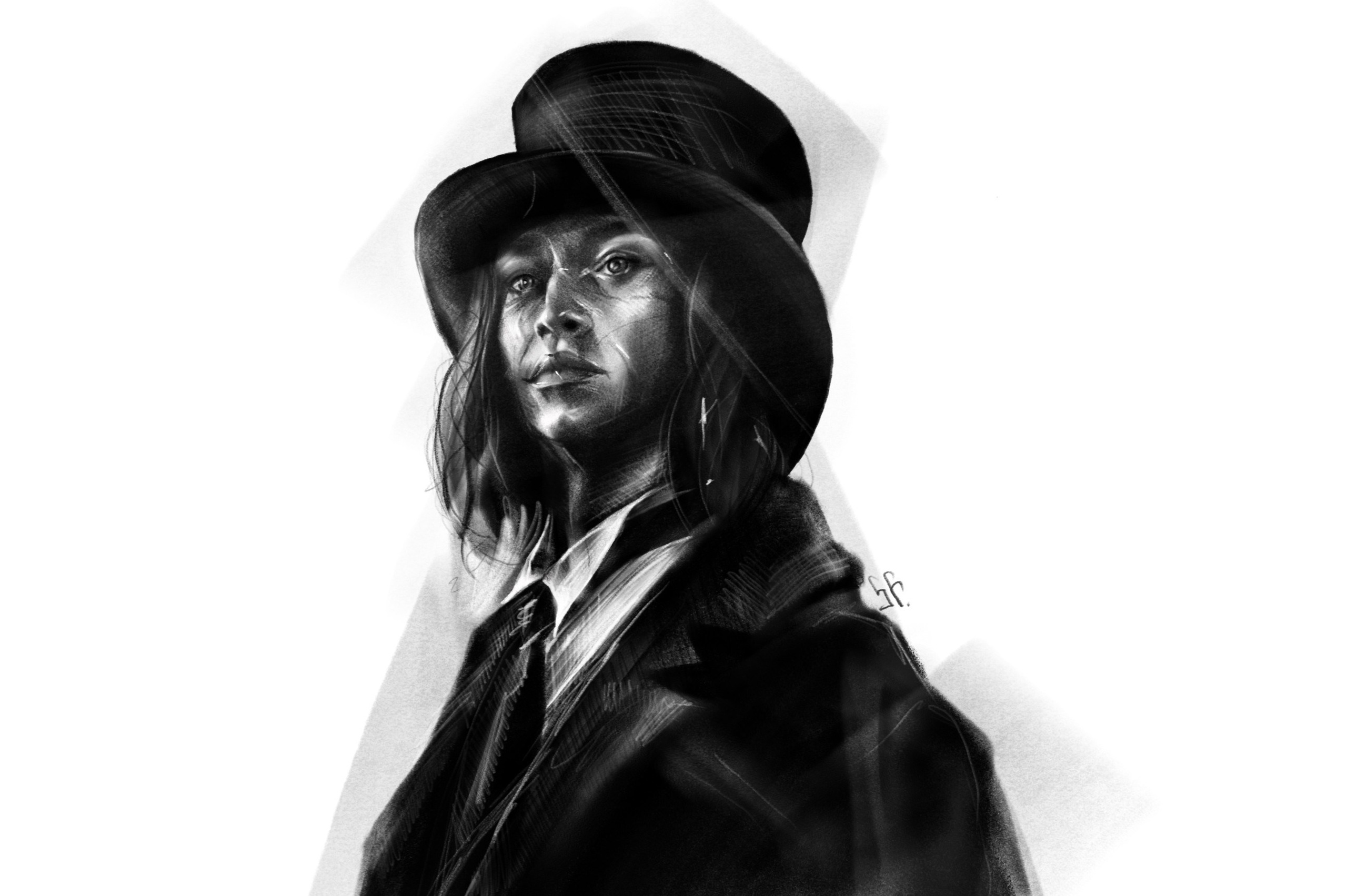
He renounced God in the name of love, and love in the name of God
Love first lifts a person to almost divine heights, and then that same love pushes them down into a darkness without God.
The film opens in the fifteenth century, and Besson deliberately gives the viewer time to see not the future monster, but a man loving hungrily. But the more tangible the happiness, the more terrifying its disappearance will be.
For Vlad, Elisabeta is not merely a wife. He elevates her almost to the status of something sacred: she is his proof that God exists and is good, a living confirmation that the world is just. He prays for her not out of duty, but because he cannot imagine a prayer that doesn’t include her. She is woven into every appeal to heaven, into every word of gratitude, into every plea for protection. To love her and to believe in God are, for him, one and the same movement of the soul.
They are separated by a war he wages in the name of the church, in the name of that very God to whom he has just prayed for his wife:
I will fight in his name, but I ask one favor of him — protect my wife.
Elisabeta dies in his arms. Vlad triumphs and returns a victor, a man who has fulfilled his duty to the church, to God, to the crown. But the church for which he shed blood failed to protect the one thing he lived for.
— God gave you life. You must honor and serve him.
— But he also gave me love. He cannot blame me for being unable to live without it. If he takes her life, he can take mine too.
Before this loss, his faith had been nearly absolute — but if the greatest gift can simply be taken away, what is faith but an illusion of control?
Vlad’s pain is almost physically palpable: it aches in his bones, his body remembers that she existed and refuses to understand that she no longer does. Every breath becomes an effort, because with her the reason to breathe disappears too. A man who, an hour ago, was a warrior, is transformed in an instant into a being stripped of any reason to exist.
And it is here that rage is born — deeply personal, addressed directly to God:
Tell your god that until my wife is alive again, my life does not belong to him.
It is at precisely this point that the vampire is born. The curse here is not a gift or a punishment from outside, but a direct consequence of an inner choice. Immortality was never a reward — it is the price Vlad pays for his own grief and fury at the world.
Besson has turned Bram Stoker’s Gothic novel into a story about a love that neither centuries nor death can destroy. The director deliberately steers the viewer away from the familiar aesthetics of vampire horror toward an aesthetic of unresolved grief. Dracula cannot die in order to be reunited with his beloved, yet he lacks the strength to live without her
The action shifts to another era, where Vlad meets a woman strikingly similar to Elisabeta — and in this recognition lies the film’s central emotional trap. Four hundred years after his waiting began, Dracula meets his love again, now in the form of young Mina.
Besson, in essence, tells a rather cruel story, and the cruelty lies not in the vampire aesthetic but in the very construction of the plot. Dracula: A Love Tale is built on a symmetry that’s easy to miss beneath the beautiful imagery: the film begins with love being taken from Vlad, and ends the same way — only now it happens to Mina.
The final scene in the castle pushes this symmetry to its limit. Mina begs him to stay, falls into hysterics, because for her this is not a philosophical question about the right to hold on to an immortal soul, but a concrete, physical loss of the person she had searched for by instinct her entire human life. Vlad acts against her wishes. He decides to die unilaterally, appealing to faith and repentance, to the idea that he has no right to drag her into the same curse.
— She is my salvation!
— But you are her damnation.
Dramatically, this looks like an act of redemption. From Mina’s point of view, it is a repetition of the very violence Vlad once accused God of committing.
And this is where the film’s true ruthlessness lies — far more expressive than any scene of blood. For half the film, Vlad takes revenge on the universe for stripping him of the right to be with the one he loves. And in the resolution, he strips that same right from her, simply disguising it as nobility and faith. He takes it away at the very moment Mina has finally found what this entire four-century story of waiting existed for in the first place — that same hungry, trembling love. She gets it for only a handful of scenes, and is immediately left holding ashes, with bone-deep pain.
One could argue at length whether Vlad’s act was driven by love, by faith, or by plain guilt before the God he once betrayed. But the outcome for Mina doesn’t change depending on his motives: she is doomed to suffering regardless of how pure his intentions were. The film seems to formulate its central, unspoken thesis — that in this story, love does not save and does not redeem; again and again, it leaves the person who loved with empty hands, quite literally. First it was Vlad. In the end, it’s her.
